Puddle Jump Through Life With Us - Living... Loving... Growing... washed in the love of Christ

Puddle Jump Through Life With Us - Living... Loving... Growing... washed in the love of Christ

Become a Fan on Facebook

Twitter Followers

Flowing River of Blessings


It's time for a good book
Showing posts with label physics. Show all posts

Tuesday, January 13, 2015

Physics and Galileo for Kids


PLEASE NOTE: Disclaimer: This blog post is an unofficial review. I was not asked to review the books mentioned, nor was I compensated in any way. I was not even given free product in exchange for my opinions. THIS "REVIEW" IS SOLELY MY OPINION.

I started using a book with my Third Grader called "Christian Kids Explore Physics" by Robert W. Ridlon, Jr. and Elizabeth J. Ridlon from BrightIdeasPress.com.


Not long into the book, there is a list of inventors to explore. We are now sidetracked, starting with Galileo Galilei.  I found a couple books from the library that would be suitable for a child, and I really liked one of them in particular.

It's called, "Galileo's telescope". It's part of the Stories of Great People series.

The book is written by Gerry Bailey and Karen Foster and illustrated by Leighton Noyes and Karen Radford from Crabtree Publishing Company.

The book starts with two children wandering into a modern-day flea market where they find an old telescope, and the man at the booth of the flea market who is selling the telescope, begins to tell the children the story of Galileo. The book continues throughout the story shifting back and forth between current day and history (with text and pictures on blue shaded pages).


Some other stories that I hope to pick up from the library from the same author/publishing company with the same modern day/history storytelling style include:

  • Columbus's chart
  • Leonardo's palette
  • Martin Luther King Jur.'s microphone
  • Mother Teresa's alms bowl
  • Mozart's wig
  • Shakespeare's quill
  • The Wright Brothers' glider
And, there are others (see picture above).

In the children's book about Galileo, I learned more about the man than I ever had from any science class of my own education.

I learned that his dad was a musician. Why is this important? Because my children are being raised by a dad who is a musician. Galileo's dad also taught students an instrument similar to the guitar - a lute. My husband also teaches students, the guitar.  Galileo's dad conducted experiments using math and music, music theory, and worked with how math affects the tension of the lute's chords to form different sounds.

I also learned that Galileo did not receive honor in his lifetime. In fact, it was more than 300 years after his death before the Catholic church admitted they had been wrong about his views.

I learned that the Bible's passage that talks about "And, the truth shall set them free." can be applied to Galileo's search for scientific truth and that even the Bible talks about the skies and the heavens proclaiming the glory of God. His new knowledge about the universe did not defy the Bible but enforce its truths.

I learned that even though something is considered to be acceptable fact - Like Aristotle's ideas of how fast objects of different size travel and how he thought the earth was the center of the universe - doesn't mean it's true. Popularity does not equal reality.

I learned that Galileo did not invent the telescope, but improved upon it, making it 30 times more powerful. And, I also learned that after he was sentenced to house arrest and accused of heresy, he ironically kept inventing - This time, he focused on the microscope (a direct opposite of the experiments that got him into trouble).

Another fascinating fact that I never knew was how he invented the pendullum clock - By watching a chandelier sway back and forth.

Another fascinating fact about Galileo is his observations of the surface of the moon.

I have a new interest in Galileo, and am happy to have stumbled upon this children's book.

Here's some more fun facts and vocabulary words associated with Galileo in the form of a quiz (answers at the end of the blog post):

  1. What year was Galileo born?
  2. In what city was Galileo born?
  3. Whose theories did Galileo prove wrong with his gravity experiment and with his studies of the universe and how it revolves?
  4. What did Galileo invent after watching a chandelier sway back and forth in rhythm?
  5. What did Galileo invent that is an instrument that measures air temperature?
  6. Name three other inventions that are credited to Galileo
  7. What did Galileo's bodies that float on water experiment reveal?
  8. What year did Galileo create his telescope?
  9. What was the name of Galileo's 1632 book?
  10. What church denomination accused Galileo of heresy?


*********************

Vocabulary:

astronomer
constellation
cosmographer
geocentric theory
heliocentric theory
heresy
mathematician
pendulums
physicist
projectiles
refracting
solar system


**********************

1503 - Leonardo da Vinci painted Mona Lisa
1508 - Michelangelo began painting the Sistine Chapel
1519 - Ferdinand Magellan set out to sail around the world
1543 - Nicolaus Copernicus published his theory of the sun being the center of the universe
1552 - Books about astronomy were burned in England being said to be associtaed with witchcraft
1564 - Galileo Galilei born, February 15
1564 - Shakespeare born on April 26
1597 - Galileo invented geometric and military compass
1607 - Jamestown, Virginia founded in America
1609 - Galileo improves the telescope
1611 - KJV King James Version of Bible printed
1620 - Pilgrims arrive at Plymouth Rock in Massachusetts
1632 - Galileo writes "Dialogue on the Two Chief World Systems"
1633 - Galileo charged with heresy by the Catholic church in Rome
1642 - Galileo died on January 8
1642 - Isaac Newton born on December 15
1992 - (That's right, 1992 - 350 years after Galileo died) The Catholic church officially admitted error in condemning Galileo

*********************

ANSWERS TO TEST:

  1. Feb 15, 1564
  2. Pisa, Italy
  3. Aristotle
  4. The pendulum clock
  5. A thermometer
  6. Hydrostatic scale, pump and irrigation system, geometric and military compass, thermometer, telescope, microscope, pendulum clock (any three are acceptable).
  7. That objects floating on water are suspended because of their lighter weight, not because of their shape, as Aristotle had believed.
  8. 1609
  9. 1632, he published "Dialogue on the Two Chief World Systems"
  10. The Catholic church


Friday, October 31, 2014

TOS Review: Fascinating Physics Flipping Education for Middle and High School Online Education

Fascinating Education Review
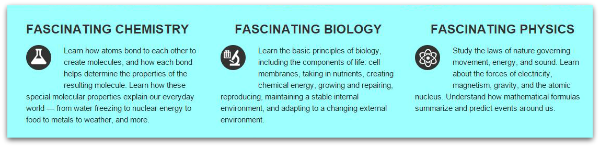
I was so excited to get the chance to review Fascinating Physics from Fascinating Education. I received a full year's worth of access to the online learning site, which is available for $79. The courses they offer are for Middle School through High School, depending on the course you decide to take. The Physics class is intended for a high school level student. They also offer Fascinating Biology and Fascinating Chemistry.
~
THE COST: If you register for two of the classes, the yearly fee is $125, and if you sign up for all three courses, the fee is $175 for the year.
~
Fascinating Education Review
~
The instructor is Dr. Margulies. He is actually a neurologist, so he understands how the human brain functions. The concept behind the site is to "flip" the learning process by approaching learning through the right hemisphere of the brain. So, what does this mean in terms of how the site is set up?
It means that instead of the traditional text reading assignments, he presents the lessons in audio clips and pictures. The lessons begin with everyday observations and concepts that the student is most likely already familiar with, and then asks questions as to why this is how it is.
~
Dr. Margulies' approach assumes that the student knows nothing about the chosen science course of physics, biology, or chemistry and then presents the information in slow bite-sized pieces that follow a complete line of thought along a story line, and demonstrates how the science course answers questions to everyday observations. It uses tests frequently to make sure the student is grasping the concepts along the way.
~
Fascinating Education ReviewFascinating Education Review
~
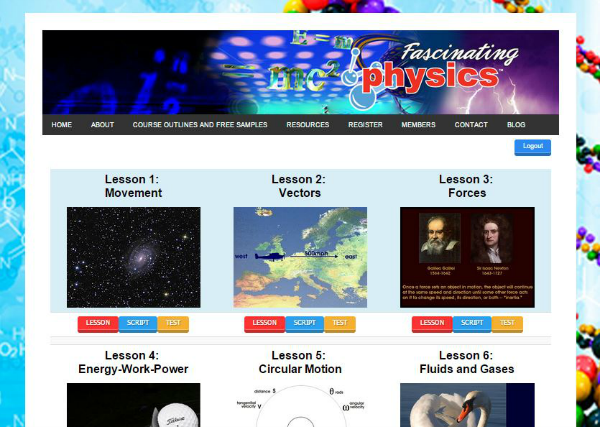
There were 15 online lessons that included quizzes and text scripts. I had my 9th grade son log on to learn. He watched the online video lessons, which are broken down to several very short videos within each lesson. The lessons also provide the script if you prefer to read the lesson, and these scripts can be printed out. The lessons each conclude with an online test.
~
Lesson 1 - Movement
Lesson 2 - Vector
Lesson 3 - Forces
Lesson 4 - Energy-Work-Power
Lesson 5 - Circular Motion
Lesson 6 - Fluids and Gasses
Lesson 7 - Waves
Lesson 8 - Light Part 1
Lesson 9 - Light Part 2
Lesson 10 - Light Part 3
Lesson 11 - Electrical Charges
Lesson 12 - Moving Electrical Charges
Lesson 13 - Electrical Currents
Lesson 14 - The Atom
Lesson 15 - The Nucleus
~
The video lessons cover a wide variety of examples of approaching the topic with lots of colorful graphs and pictures that correspond with the lessons in a Power Point style presentation with the instructor talking throughout.
~
Each lesson contains approximately 25-38 short video lesson clips that are separated so that you can easily review the portions of each lesson that you need to focus on more, or easily find a topic that was covered. I thought that my son could sit down and complete one lesson per sitting, but I very quickly discovered that it's so much better for him to learn each lesson in smaller chunks of no more than 1-5 slide/video clips per day. Another student may be able to tackle more or even less, but it's nice to have the flexibility of learning as much or as little at a time that each student is able to handle. It's also nice that if you stop in the middle of a lesson, the screen will ask if you want to continue where you left off at your next log in.
~
The tests are like an open book test, because there is a NEED HELP? button that the student can click on if they get stuck and don't know the answer. When you click on that button, it shows the video clip that explains the specific test question. The tests are each fill in the dot/SAT style multiple choice. The student selects the answer and then hits submit. Once you hit submit, you see your immediate results and where your percentage lies as to whether you passed or did not pass. From there, you can print the results, review the quiz, or retry the quiz.
~
Even though this right-brain approach to learning science doesn't emphasize the need to learn terminology, there is also a Glossary tab that contains key vocabulary words inside each lesson. I really liked having this right there with easy access.
See what other Crew Members thought by clicking on the picture below:
 
Click to read Crew Reviews
Crew Disclaimer

Thursday, June 16, 2011

Teaching To Learning Styles with Exercise Balls, LEGOS and Visual Cues

Do you ever feel like you're droning on and on and on when you read something to your child. It's as if you're talking but no one is listening, or even interested in listening. Or, perhaps, one child gets it plain as day when you read, but the others do not. Why? This is probably because one child is an auditory learner while the others are visual or kinesthetic or tactile.

Kinesthetic learners can be a challenge to instruct for the parent who would prefer to sit quietly while instructing. This is because they require constant motion. Some schools have even gone to using exercise balls for the children to sit on while they listen to instruction as it gives them movement which helps these learners learn best.

Teaching visual learners is all about providing enough instruction through the child's sense of vision. This can be done in a number of ways, by using video, pictures, large books or visual cues. Following is a great article on how to use visual cues to help students learn:

What Are Visual Cues And Teaching With Visual Cues

For the Hands-On Learner, the one who understands through the sense of touch, toys like LEGOS can prove to be your best friend. You can even instruct complicated theories and teaching such as how physics & mechanics work, by using LEGOS. Following is a fun article that explains how to use LEGOS to teach Mechanics in Physics:

Teach Physics & Mechanics With LEGOS